

- 37 Views
- 9 Min Read
- (0) Comment
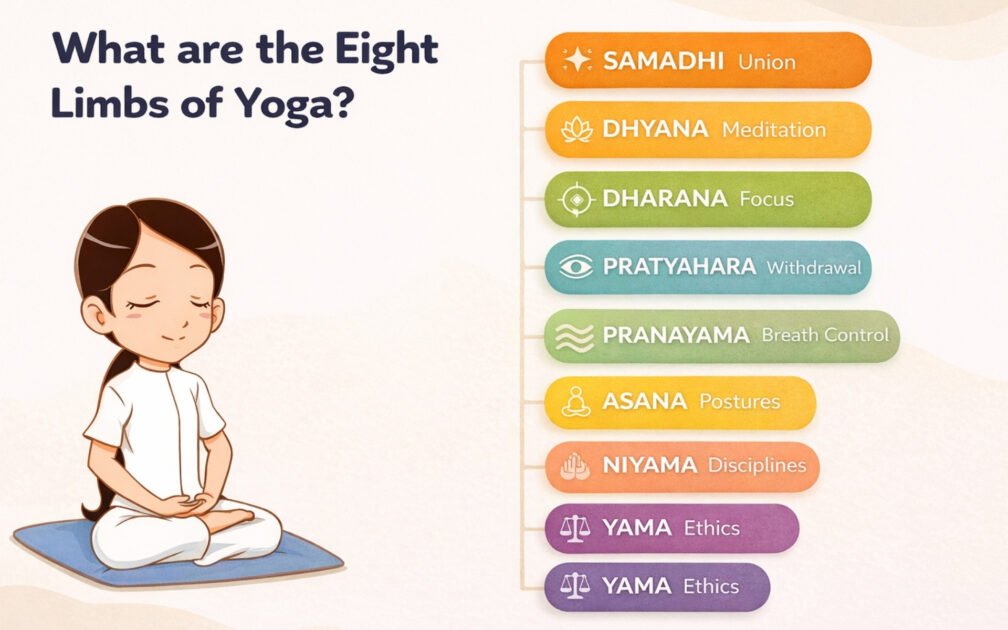
Yoga is an ancient mode of existence that offers a whole world of philosophy to lead a healthy, happy life to its fullest. Yoga as a discipline dates back over a decade. Three of the most common ancient readings are The Rig Veda, Patanjali Sutras of Yoga, and The Bhagavad Gita, among many others that provide information on yoga. They articulate deep philosophical yoga and numerous transformative yoga practices. The eight limbs of yoga help a person live a disciplined, peaceful, and balanced life.
Eight Limbs of Yoga Explained for Beginners
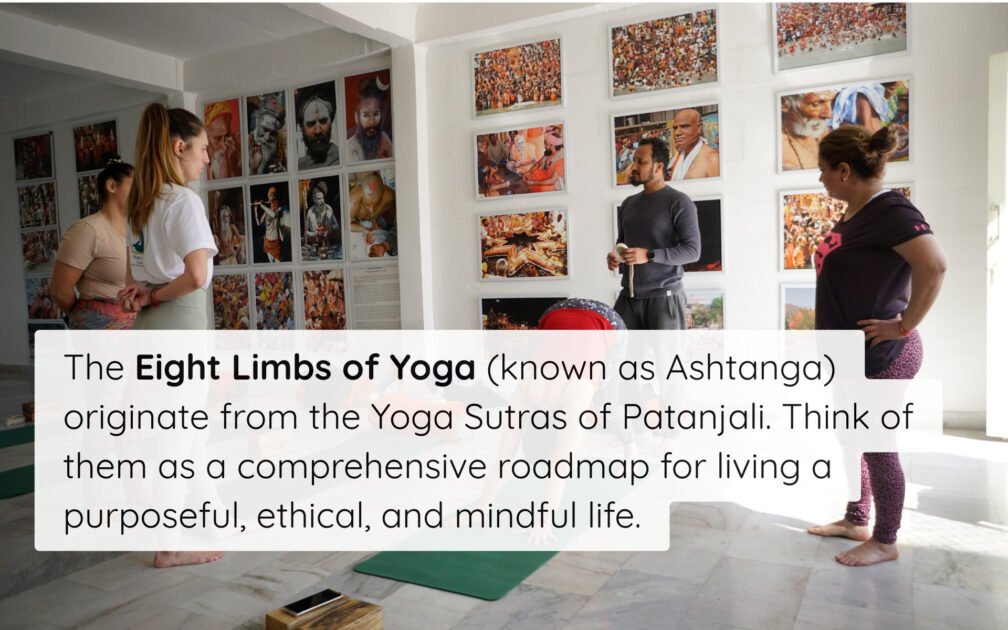
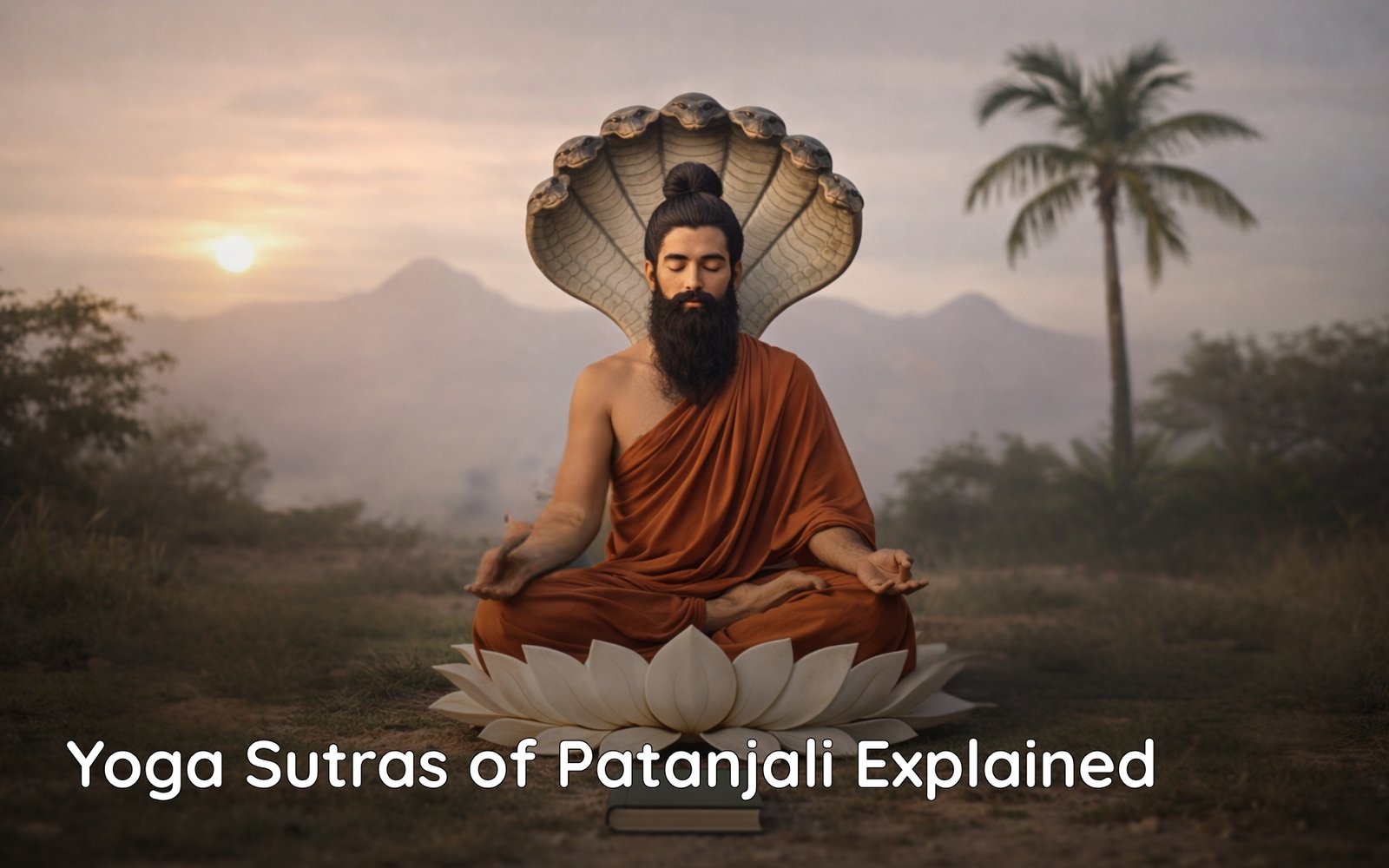
Ashtanga yoga eight limbs show the complete path of physical, mental, and spiritual growth. Patanjali has one hundred and forty Sutras (or writings) which are organized into four discursive parts or padas. The eight-fold path of yoga is practised by the second section that is known as the Sadhana Pada.
Patanjali eight limbs of yoga are described in the ancient Yoga Sutras. Sage Patanjali in this chapter refers to this eight-fold path as ashtanga yoga in Sutra 29. He came up with this road to enable us overcome human suffering and to achieve a state of self-realisation and perfection. Simply put, this lifestyle encourages a successful cooperation of the body, mind, and spirit and attains mental and physical wellness and health.
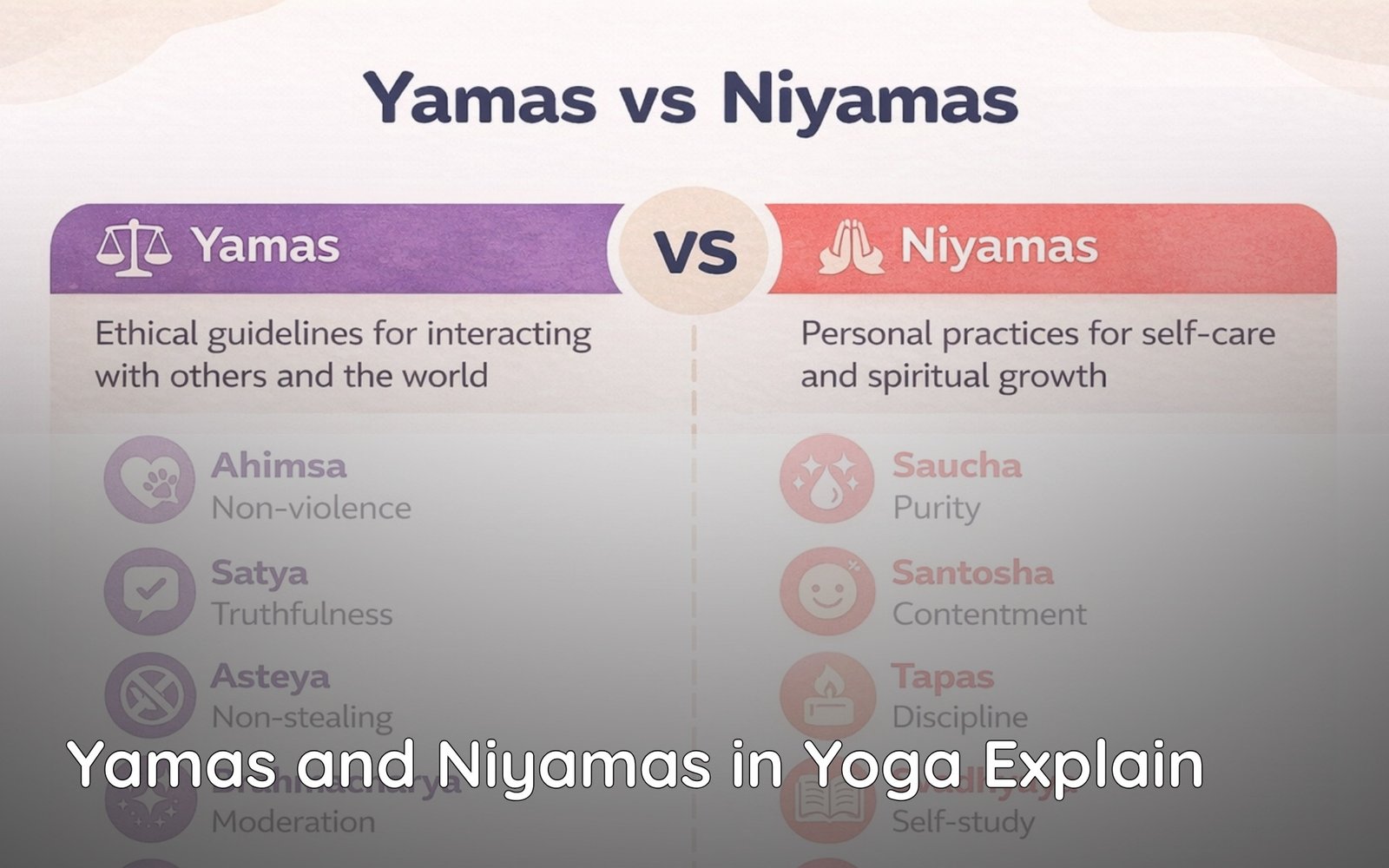
Yama (Restraints)
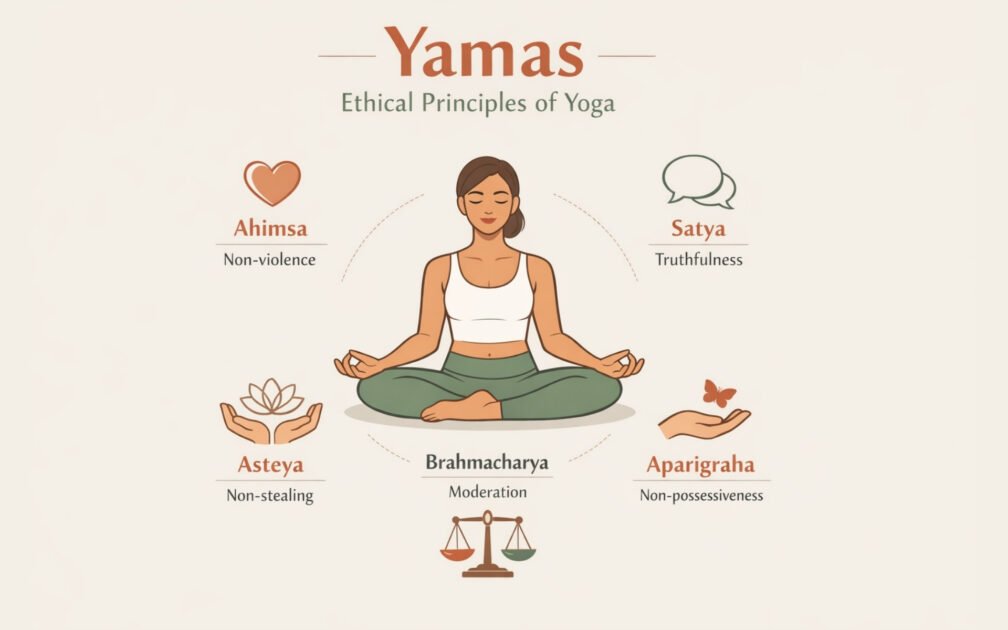
There are five moral principles that are used to define a code of conduct that is supposed to be followed when dealing with the surrounding world. They provide instructions on what to do when relating to others. They are:
Ahimsa (Non-Violence): Ahimsa was very uncomplicated to the audience of the original Yoga Sutras. Moreover, other modern yogis also interpret ahimsa and choose to go vegan since all living things have the right to be handled with compassion and non-violence. Patanjali eight limbs of yoga guide practitioners toward self-control and inner peace.
Satya (Truthfulness): Speaking the truth is an ethical foundation we all are likely to support, and it is, by the way, not an old-fashioned one. As a matter of fact, in the era when it is allowed to shield your eyes with the so-called alternative facts in the ultimate spheres of social life, one can and should speak truth and help other people who do so. The eight limbs of yoga for beginners are easy to understand and practice step by step.
Asteya (Non-Stealing): This certainly was in Patanjali’s age, mostly an injunction against the stealing of property. Although the adage remains valid (not to mention the law), nowadays there are just too many more ways to steal, some of them not particularly conspicuous. Intellectual property, logos, internet pictures: whatever is not yours, let it go. The limbs of yoga explained simply, help people understand yoga beyond body postures.
Brahmacharya (Celibacy): Yoga would not be the first school of thought that would encourage its followers to be celibate. Fidelity, constancy, openness and an honest relationship with the partners we have is becoming an alternative to modern-day yogi householders. The Yoga sutras eight limbs explain how to control the mind and behavior.
Aparigraha (Non-Coveting): Jealousy, envy, coveting what other people have, all these words describe the green-eyed monster which, seemingly, haunted us since the dawn of our existence. It’s a tough one to get past. One of them is naming the sensation when it happens to be aware that it is happening, and then can understand that we need not get attached to it.
Niyama (Observances)
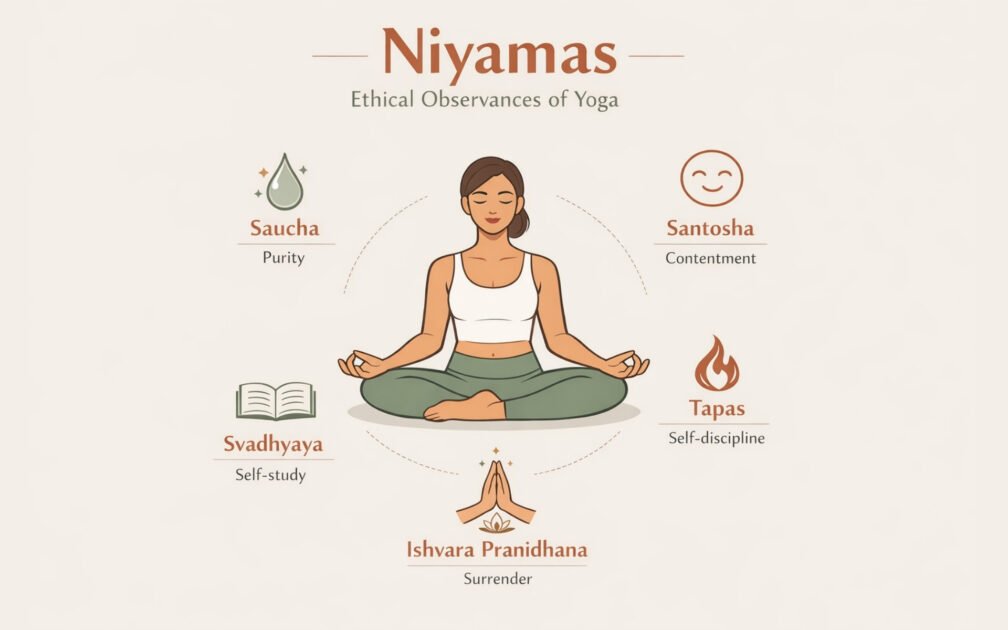
When they are directed towards society, then the niyamas are directed towards the self to enhance the self. They are:
Saucha (Purification): Yoga Sutras prescribes purification of body and mind, a prerequisite step in getting rid of the physical world to prepare for meditation. In our case, this may involve recognising and dropping thought patterns that may so easily distract us from our purposes. What are the eight limbs of yoga? It is a common question for new yoga learners. When we can get the thoughts that abide in negativity or meanness towards ourselves or others out of the way, then there will be less clutter in that way at the time we give our internally directed attention.
Santosa (Contentment): Satisfaction is a practical issue for most individuals and, therefore, worth exploring the reasons why people find it hard to be content with themselves. This culture of desiring more, desiring status, desiring never-ending striving to become better is widespread and acting upon it requires some effort to actually realise that this is not a requirement.
Tapas (Asceticism): It is a key part of the translation of tapas that heat can be seen as one of the most effective translations of this word because the idea of heating the spine of our inner flame is promoted. In modern yoga, tapas could be seen in daily exercising of postures or meditation that has to be controlled with self-control. The meaning of eight limbs of yoga is about living a moral, mindful, and focused life.
Svadhyaya (Study): Sometimes it is translated as self-study, meaning that it is introspection, but that does not appear to be the original goal. Instead, it entailed the study, learning and repetition of holy prayers and mantras, which was and still is normal in Hinduism. The eight limbs of yoga, with examples, help people apply yoga principles in real life.
Ishvara Pranidhana (Dedication to God/Master): It may be a delicate one for many contemporary practitioners. It is interesting to observe that the original meaning of Ishvara can be interpreted. It might have been a master, a teacher or an unknown god. The submission to a teacher conforms to the guru-student relationship that was already established in Indian yoga. Patanjali Yoga Sutras eight limbs explained clearly the path to self-realization.
Asana (Posture)
Although this may sound like we are treading ground we are more familiar with, asana also provided a very different meaning in its original setting.
Although the term is used currently to describe any aspect of a figural practice (all yoga poses), it simply meant a comfortable seat in the first place. There are no other instructions on asana or Patanjali besides the need to find a posture where one would perform the practice of pranayama and meditation.
Pranayama (Breath Control)
Under breath control, Patanjali teaches that the student must undergo inhalations, exhalations, and retention of the breath cyclically. A simple explanation of eight limbs of yoga helps everyone understand yoga easily.
Other breathing exercises, which we now perform, have their origin beyond the Yoga Sutras. The eight limbs are all involved in the preparation to meditate. Therefore, any breath that centres the mind and makes us aware of the present moment assists us to prepare the body and mind to shift the focus inwards.
Pratyahara (Cessation of the Senses)
Separating consciousness from the distractions presented by activity in the senses is the last physical preparation for the meditation practices offered in the last three limbs. This may itself be a kind of what we might call mindfulness, whereby the external input, like sounds, feelings, or smell are perceived as such and then given the freedom to pass without our attention being drawn.
Dharana (Concentration)
The initial level in the inner journey towards the lack of suffering is dharana. In such meditation, all the attention of the practitioners is directed to one of the points of focus, which may be the navel or even an image in their mind.
Dhyana (Meditation)
At this phase, the practitioner focuses his or her attention on one object only and excludes all the rest. Although we are used to a form of meditation which tries to empty the mind of all thoughts and images, it does not appear to have been the obligatory step of the process relating to Patanjali. The point of focus is all it takes to make the object unspecified.
Samadhi (Pure Contemplation)
Once dhyana is reached, the meditator goes into a state of samadhi where he or she becomes united with what he or she is meditating on. Even though this has been seen to imply coming into operation with the godhead or even the universe, the meaning of the union in the teachings of Patanjali does not go that far.
Conclusion
The eight limbs of yoga with examples prescribed by Sage Patanjali provide a full road map to leading a beautiful and stable life, not only a physical Yoga practice. Although most individuals equate yoga with poses, the eight limbs of yoga help to remind us that yoga is not all about poses, but ethical, lived, self-disciplined, breath-conscious, mentally focused, and a still inner being.
Through careful integration of these principles, mindful behavior (Yama), healthy routines (Niyama), conscious movement(Asana) and breath control (Pranayama), yoga becomes a lifestyle and not merely an exercise. You do not necessarily have to perfect everything in eight limbs all at the same time. Being conscious of one of her legs can bring more clarity and relaxation to simply living.
FAQs
Are the Eight Limbs of Yoga religious?
No. As a discipline of Yoga, the Eight Limbs are philosophical and practical principles rather than religious ones. People who follow any religion can practice it as a tool to be mindful, disciplined, and know themselves.
Do I have to do all eight limbs to have a positive effect of yoga?
Not at all. Even a narrow area, such as addressing one or two limbs of ethics, posture, or breath, can be of great help. Yoga is a gradual process and not an all-or-nothing one.
Is the most significant limb of physical yoga Are Asana?
The postures are the most significant, but they are not the only segment of the path of yoga. The Eight Limbs also stress that mind discipline, breath awareness and inner focus are equally as important in long-term well-being as much as not more.
What are the beginners to do to begin practising the Eight Limbs of Yoga?
Beginners can start by:
- Basic yoga postures (Asana) practising.
- Acquiring simple breathing techniques (Pranayama).
- Putting into practice Yama and Niyama using benevolence, sincerity and self-care.
It is more effective to make small but regular steps than to do everything simultaneously.
Is it possible to make use of the Eight Limbs of Yoga to manage stress and anxiety?
Yes. Breath control, meditation, and mindful living are some of the practices that can still the nervous system and minimize mental clogging, better emotional control, and some yoga are very effective in dealing with stress.
Does the Eightfold Path of Yoga have something in common with the Eightfold Path of Buddhism?
No. The similarity in sound does not mean that the Eight Limbs of Yoga introduced by Patanjali and the Eightfold Path of Buddhism are identical systems with the same philosophical background.
Yoga Teacher Training Courses in Rishikesh
100 Hour Yoga Teacher Training in Rishikesh
200 Hour Yoga Teacher Training in Rishikesh
300 Hour Yoga Teacher Training in Rishikesh




Leave a comment: