

- 126 Views
- 7 Min Read
- (0) Comment
The one thing about Uttarakhand State in India is that people have different perspectives about this place; some may think of it as a place to do the Char Dham Yatra, or some picture it as a crowded street in Rishikesh or Haridwar.
But this place is way more than that, where we can see, feel, and look at the spot where no one other than the wind itself speaks a language that is yet to be understood by a lot in their own way, which means your soul can find something that it might be longing for and looking for, which we can definitely see. on a ridge in the Rudraprayag district. It is the Kartik Swami Temple.
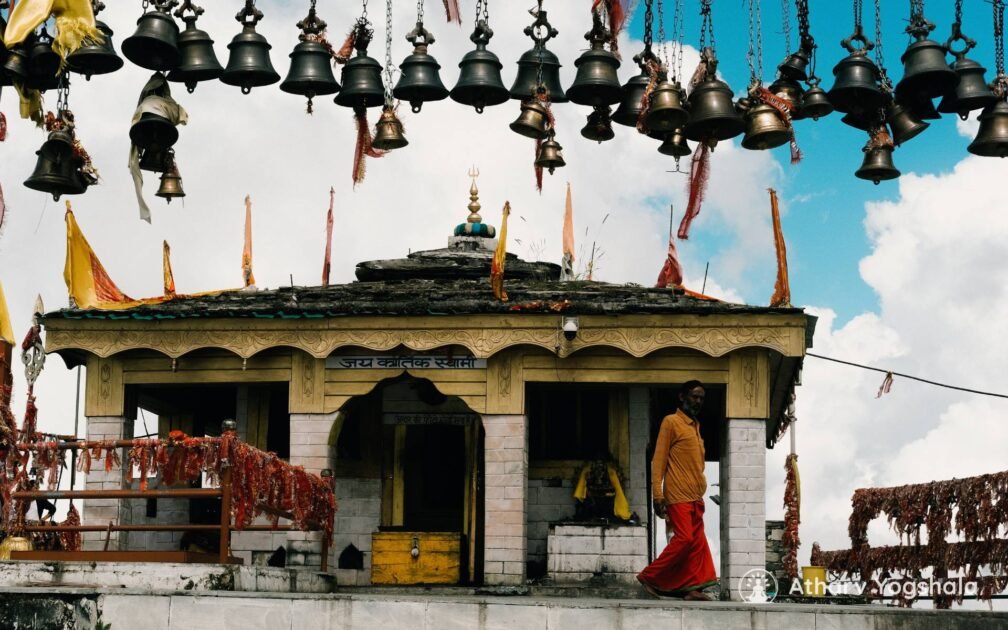
Now, suppose you have ever seen the picture of a temple on the very edge of a mountain, where you could look all around and see all of the Himalayas; you have likely looked at Kartik Swami. It is the ultimate destination for those who want a combination of nature, which is a moderate hike, and also offers a strong spirituality.
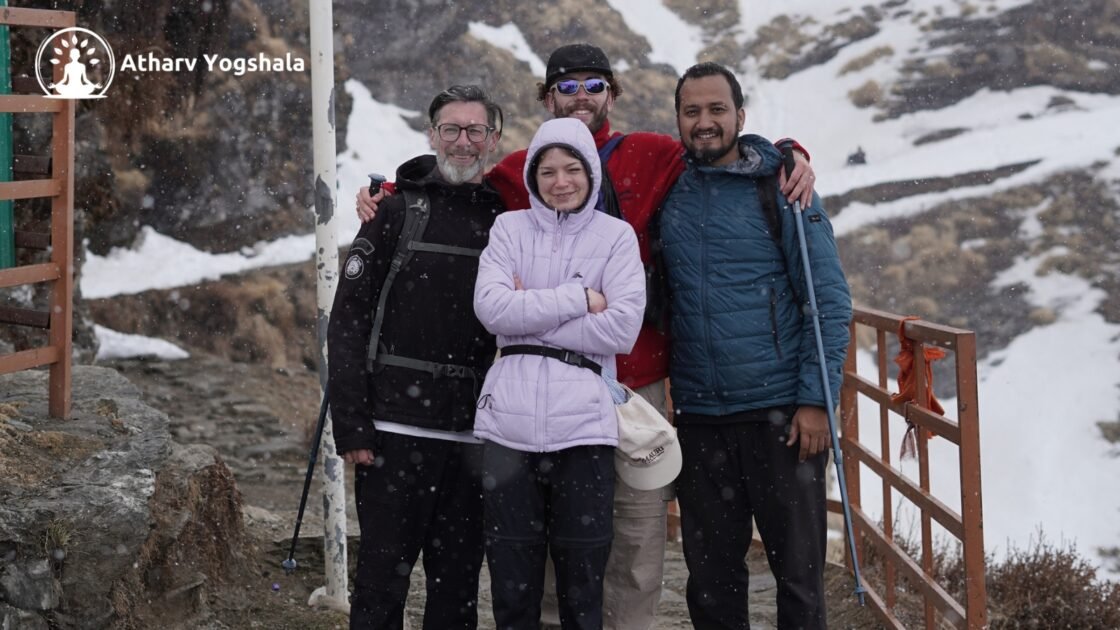
Atharv Yogshala understands that yoga is not practiced on a mat in a room; it is done on the trails. This is what makes the Kartik Swami Trek the central part of our Himalayan trip.
The Story of a Person, the History: A Story of Devotion and Sacrifice.
The mountain ascent has a long history of the Kartik Swami Temple in Uttarakhand. This temple is dedicated to the first son of Lord Shiva and Goddess Parvati, according to ancient scriptures, who is Lord Kartikeya. The history and story of this temple took us ages ago to the time when Lord Shiva, once himself, asked both his sons, Ganesha and Kartikey, along with some other gods, to go around the universe thrice, and whichever one came back in time would be the first to be worshipped.
When Kartikeya went on his round in his peacock to go around the physical world, Ganesha did not follow the same path. He just moved around his parents, Shiva and Parvati, saying that they were his universe. Ganesha won the challenge.
When Kartikeya came back and saw what had occurred, he became extremely emotional. He killed his own flesh and bones for his father in an act of great devotion and penance to show his respect. It is said that his bones are still lying there on the Kronch Parvat. There is a lot more primal and raw energy, whereas with other temples, you see a physical idol. This history has made it a great hiking place in Uttarakhand among those who wish to trace the ancient origins.
Geography: Standing on the Edge of the World.
The Kartik Swami Temple is geographically located at a height of about 3,050 meters (about 10,000 feet). It is situated in the Kronch Parvat in the Rudraprayag district.
The peculiarity of this place is its location on the Ridge Top. The majority of the temples in the Himalayas are hidden in valleys or in the slope areas, although Kartik Swami is situated directly on the mountain backbone.
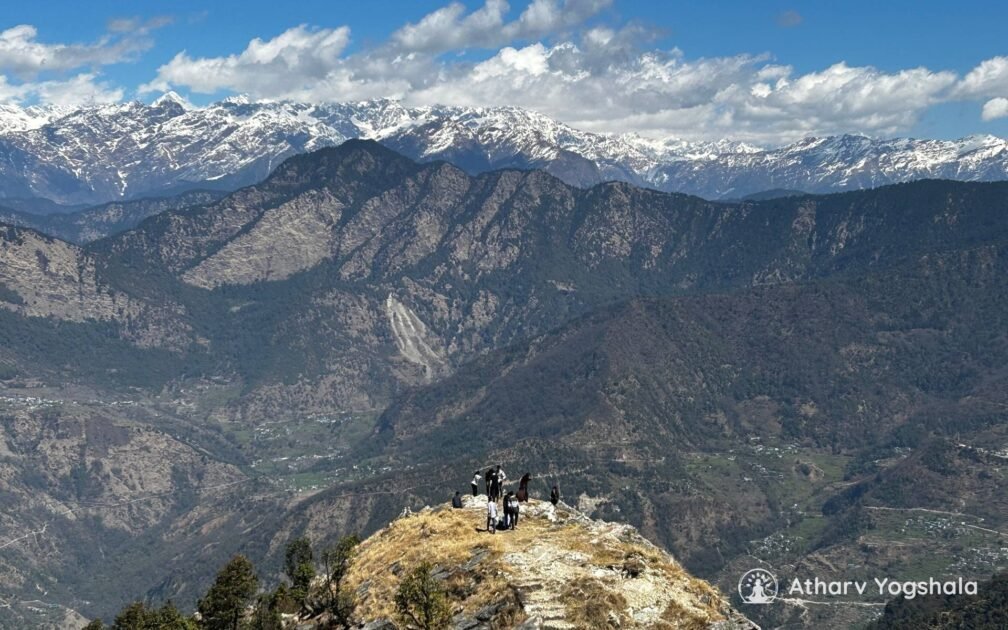
Looking at the courtyard of the temple, you are not only looking at a single mountain but at all of them. On a clear day, you can see:
- Chaukhamba Peaks
- Bandarpunch
- Kedarnath Dome
- Trishul and Nanda Devi
The pure fall on either side of the temple leaves you with an impression of flight. It is like the feeling of the Chandrashila Peak with a far greater feeling of isolation.
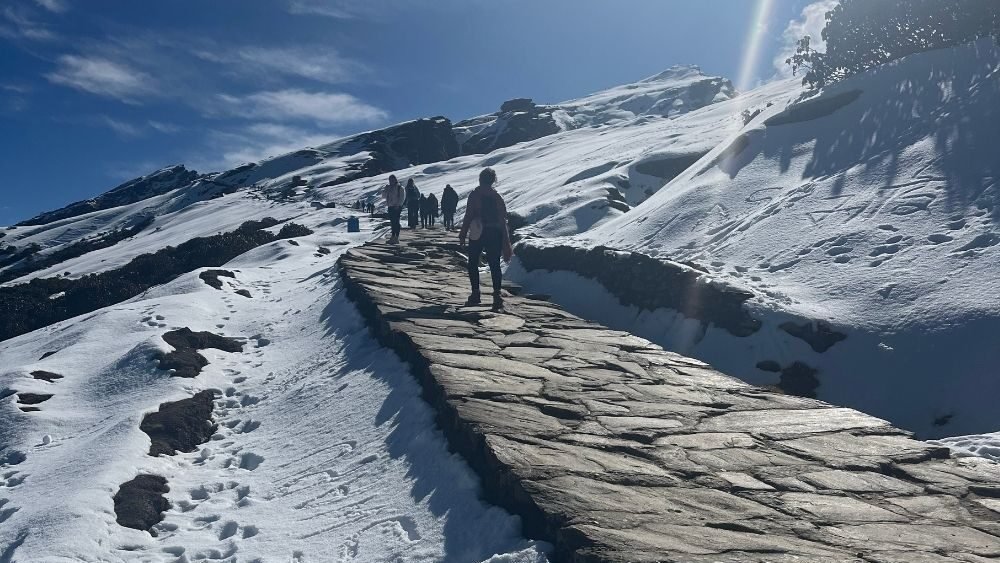
The Kartik Swami Trek: Walk through the Clouds.
Karkat Swami Trek starts with a small and quiet village called Kanak Chauri.
- Distance: About 3 km (one way).
- Difficulty: Easy to Moderate.
- Time: 1-2 hours, according to your speed.
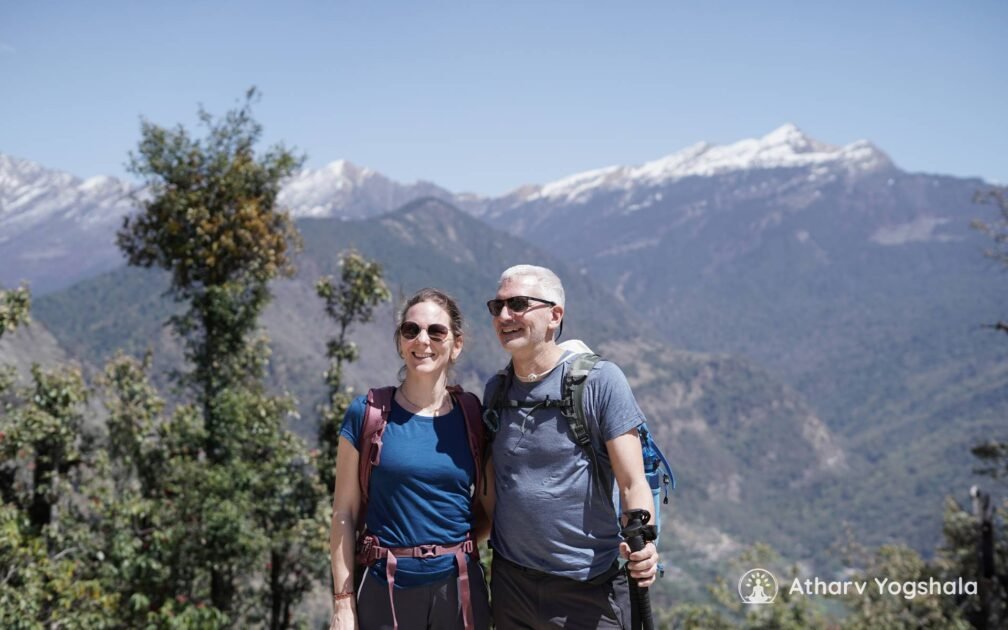
The whole trek and trail to the Kartik Awami temple is well defined for all travelers. You will see thick rhododendron (buransh) and oak forest. There are a few months, like March or April, when you can also witness the whole route decorated by the rhododendrons.
When you walk, you sometimes hear the sound of the bells beating the quietness of the forest. Thousands of bells. Worshipers whose demands are met are able to go back and secure a bell at the temple. The closer you are to the peak, the more the ringing in the mountain wind of these bells would create a meditative rhythm. It is among the most scenic treks through Uttarakhand.
Yoga and Meditation in the Himalayas: Why Kartik Swami?
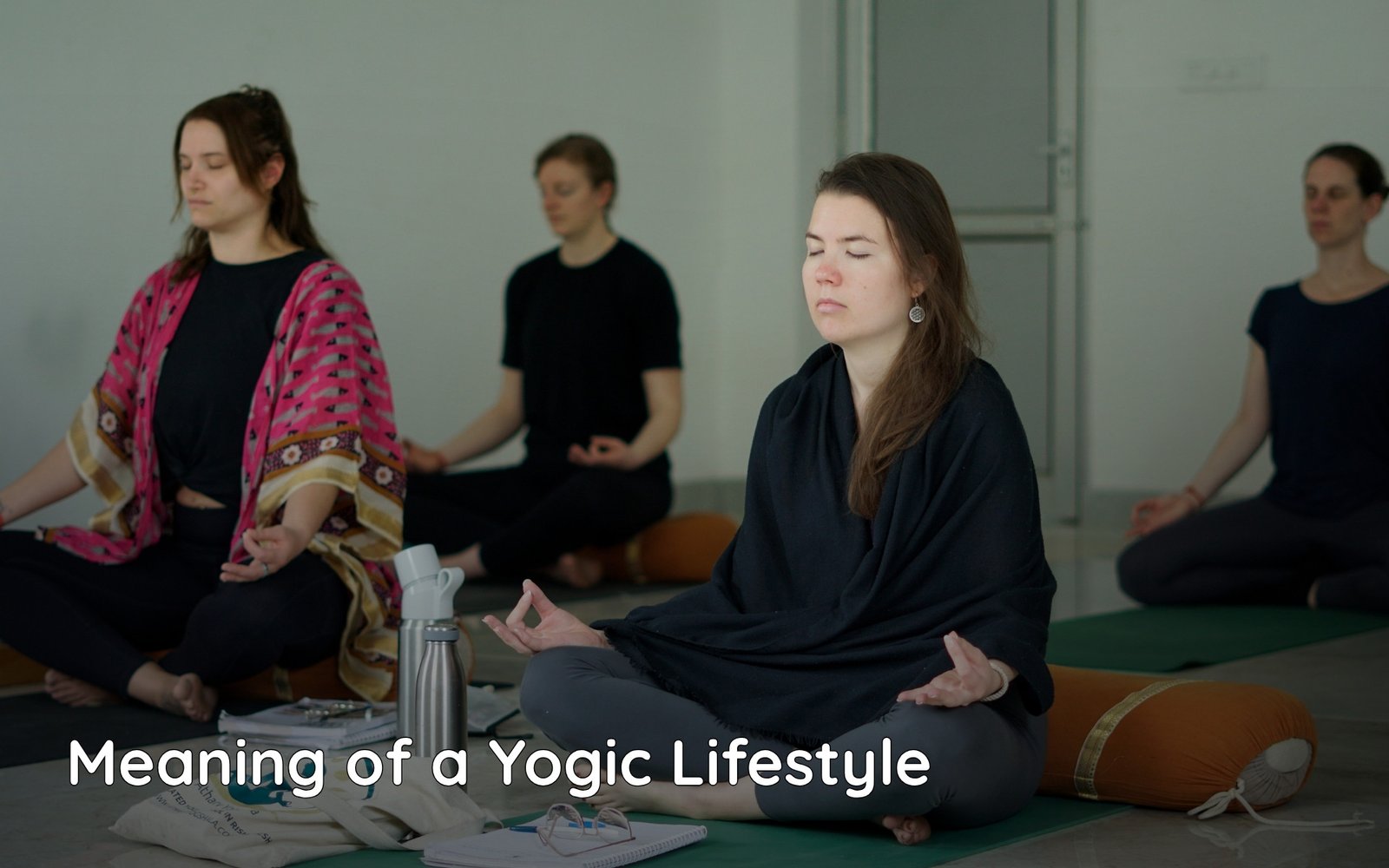
A lot of individuals inquire of us as to why we bring our students to such isolated heights of the Himalayas to practice yoga and meditation. The answer is simple: Prana.
When one is at 10,000 feet, the air is thin, pure, and charged. The Kartik Swami Temple is free of the noise of the city. Cars, markets, and very few tourists are present as compared to the main shrines.
Why Meditate Here?
- The Sound of Silence: Mouna (silence) is a subject of discussion in yoga. This is where the silence is so great that to hear your own heartbeat. It facilitates internalizing your consciousness.
- The Horizon: Gazing at the great Himalayan range assists in Trataka (gazing meditation) and broadens the perspective of the mind.
- Vibrations: The bells that surround the temple are thousands of bells that serve to play sound therapy. These vibrations produced by the blowing of the wind on these bells are claimed to cleanse the aura of the practitioner.
To a yoga student, it is a life-changing incident to sit on the steps of Kartik Swami in the sunrise. It is the point of contact between the physical exertion of the journey and the spiritual calm of the mind.
Uniting the Spiritual Path.
Going to Kartik Swami is not an empty experience. To do this, one normally passes through the middle of the Garhwal Himalayas, passing by some other high-energy points.
If you are making yourself ready for the trek ahead, there are a few things suggested for you, one of which includes taking part in the most auspicious Ganga aarti in Rishikesh, which makes you feel energized, happy, and satisfied, and also prepares you both internally and physically to set off to the mountains ahead.
After Rishikesh, you set foot on Devprayag, where you will get to see the Devprayag Sangam, also known popularly as the confluence of the Alaknanda and Bhagirathi rivers, and then you will resume your journey from there to Rudraprayag. This meeting point may be defined as a physical representation of balance in the same way that breath and body meet in yoga.
We normally rest on the road at a Dhari Devi Temple, the goddess of the Char Dham, which is right by the Alaknanda banks. Just as in the Kartik Swami Temple in Uttarakhand, Dhari Devi reminds one about the power of the Divine Feminine in nature.
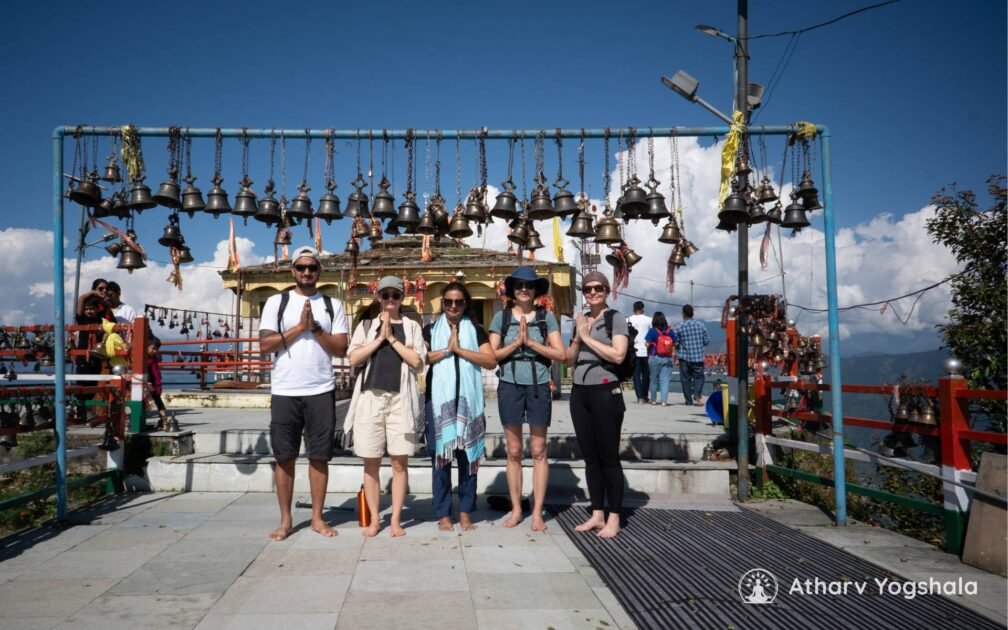
The location also has hikes to Deoria Tal, a pool of emerald, which is seen through the Chaukhamba peaks, and the renowned trek to Tungnath and Chandrashila Peak in case one has an additional dose of height. Even though Tungnath is the highest Shiva temple, Kartik Swami is farther far-off and path and spiritual.
Conclusion: Getting a membership in Journey with Atharv Yogshala.
It is not a walk to a temple or picture of the Himalayas, but a walk to Kartik Swami at the end of the day. It has to do with the change that occurs in you. By the time you complete the trek, you are a tourist, but once you conclude and ring the final bell, you are a seeker.
Atharv Yogshala includes such treks in our Himalayan Yoga Hiking Retreat. We believe that the steep ascents are what teach us patience, the thin air teaches us the value of breathing, and the summit on which we stand teaches us modesty.
We also visit such places as Kartik Swami, Deoria Tal, and Chandrashila because these are the classrooms of nature. The ridges of Kartik Swami are there to welcome you, whether you are an experienced yogi or a beginner in need of a spiritual recharge.
Come, walk with us. And leave the teaching to the mountains.
Yoga Teacher Training Courses in Rishikesh
100 Hour Yoga Teacher Training in Rishikesh
200 Hour Yoga Teacher Training in Rishikesh

300 Hour Yoga Teacher Training in Rishikesh


Leave a comment: