
- 256 Views
- 9 Min Read
- (0) Comment
If you think about yoga we always see images of flexible bodies, twisting the body, but these are not only yoga they are just a small part of a much bigger system. If you truly want to understand the concept of what are Yamas and Niyamas in yoga, then you have to look at them as the moral path of a yogi.
In ancient times of Patanjali Yamas and Niyamas, these were the first two limbs of the Eight – fold path. So you can say that these are the foundation of a house without them, your yoga practice would have just looked like a workout. Even modern schools like Atharv Yogshala highlight that making these ethics a part of our daily life is what actually a proper personality transformation will be. For any one who has just started doing yoga, understanding the Yama and Niyama meaning is the first step towards a balanced and peaceful life.
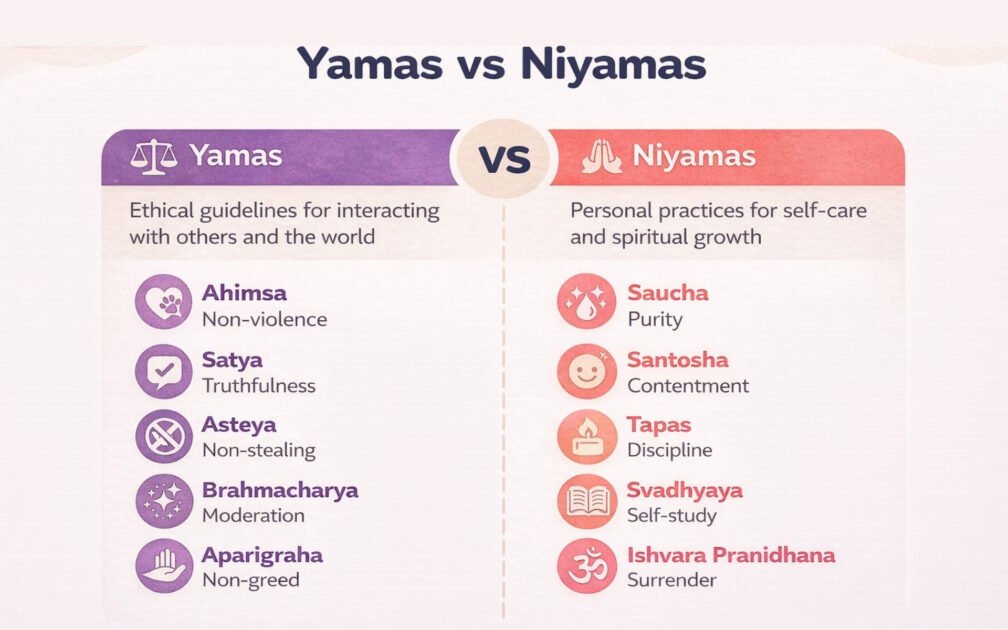
Breaking Down the Five Yamas-
The five Yamas and five Niyamas is a guide for how we can relate to the world and ourselves. Let see first at the Yamas – these are about our social conduct.
- Ahimsa- This is the most important one, in this Yamas and Niyamas explained simply that not hitting someone is not considered alone as a non- violence, but it is also about not having any violent thoughts towards yourself or others.
- Satya- This means being honest in your words and actions.
- Asteya- In this it means not taking what is not yours in that it includes someone else’s time and credit also.
- Brahmacharya- It means managing your entire energy so that you don’t feel burnt out.
- Aparigraha- In this one should not hold things or feelings, which means letting go.
Understanding the Five Niyamas –
Now let us understand what five Niyamas are. Five Yamas were focused on interaction but five Yamas and five Niyamas are incomplete without each other. In this it is a personal observation that helps us clean our inner self. If you are looking for Yamas and Niyamas daily life, then these are five points:-
- Saucha- This is not just a basic shower, it means purity from mind, body and inner self, which in Yamas and Niyamas explained simply. In Atharv Yogshala, Saucha includes eating clean food and keeping yourself positive.
- Santosha- This is the toughest one for every person specially for beginners. It means being happy with what you have right now. But in a world we are in constant hurry, yoga ethics Yamas Niyamas teach us that peace comes from your inner self not from any new materialist items.
- Tapas- It means to have commitment with your practice. Whether you plan to wake up early in the morning for yoga or in the evening, it is important to maintain discipline.
- Svadhyaya- Yamas and Niyamas for yoga beginners shows that Svadhyaya is the practice of looking in the mirror, not physically but spiritually. It includes reading something which helps you understand your own nature and personality.
- Ishvara Pranidhana- In this it means surrendering your ego to the universe. It is the self realization that you aren’t in control of everything, which then can give you immense peace and relief.
Why are Yamas and Niyamas Important for Modern Life?
You might think why should I care about Patanjali Yamas and Niyamas in 2026?, so the answer to this is very simple- that is your mental health. Nowadays we are more in stress, anxiety, and the importance of Yamas and Niyamas lies in their ability to reduce stress and anxiety.
- Stress Management: When you practice Aparigraha, you stop worrying about what others actually think of you.
- Better Relationship: For this you should practice Satya and Ahimsa which create a foundation of trust in your personal and professional life.
- Focus and Clarity: Practicing Tapas and Saucha will help you clear every confusion which is roaming in your mind that came from a chaotic lifestyle.
For anyone following Yamas Niyamas for yoga beginners, they are not just rules; they are a way for a happier life. Modern institutions like Atharv Yogshala add these into their training because they know that a strong body without a disciplined mind is incomplete.
Practical Ways to Practice Yamas and Niyamas in Daily Life-
Understanding the Yama and Niyama meaning is one thing but living that life is where the real yoga begins. For practicing these you don’t need a proper mat or dress, because these are done within yourself. Here is a Yamas and Niyamas explained simply for your everyday routine:
- On the Road: When you are stuck in traffic and someone just cuts you off, so now instead of reacting with anger (Ahimsa), try practicing doing Santosha (Contentment) at that time. This shift of your nature is the main teaching of Patanjali Yamas and Niyamas.
- At the Workplace: Yamas and Niyamas for daily life are very important and relevant for professional life. Satya means being honest about your work and deadlines, while Asteya means to not take credit for any other’s work of your colleagues. Atharv Yogshala highlights that professional integrity is a form of spiritual practice.
- On Social Media: We are in a digital world where we see other people’s lives. Aparigraha teaches us to let go of the fear of missing someone which is very crucial nowadays. Meanwhile, Svadhyaya encourages us to observe why we feel the need to scroll reels mindlessly. Are we just trying to avoid our inner self? This level of self- awareness is very important for yoga beginners.
- Maintaining Health: Saucha means keeping your digital and physical life clean, while Tapas is the discipline which is needed for workout and meditation routine even when you don’t want to do it. The importance of Yamas and Niyamas is most clearly shown when these habits start changing your physical as well as mental health and start giving you more clarity.
Yamas and Niyamas for Beginners: A Step-by-Step Approach –
If you are very new to yoga ethics Yamas Niyamas, do not try to just master everything at once. It will be tiring and boring as well, instead follow these simple steps :
- Pick One per week: Start with Ahimsa, in the one week, focus fully on being kind in your thoughts, words and actions.
- Journal Your Progress: As part of Svadhyaya, try to write down when you succeeded at something and when you struggled a lot.
- Join a Community: Learning through a program like Atharv Yogshala can provide the guidance needed to understand the deeper Yamas Niyamas simple explanation.
- Don’t Be Hard on Yourself: Remember, yoga is just a beautiful journey, not a destination. Even the most advanced yogis are still practicing these basics.
Deep Dive into Patanjali’s Philosophy-
To truly understand the benefits of Yamas and Niyamas, one must see the longer term benefit of Patanjali’s Yoga Sutras. Adding these ethics into your journey can make you more spiritual and physical strength also.
- Asana (Postures)- Yoga poses not just have stretching, but it also has some practicing which can be done without mats also. Like Ahimsa which means not to hurt anyone verbally or physically, now this can be done within oneself, and doing this can actually strengthen your body and mind.
- Pranayama (Breathwork)- Breathing is the bridge between your body and mind. Saucha makes sure that your body and thoughts are clear, which can then make your breathing more deep and effective.
- The Internal Strength- For this one person should do meditation as this is very important for your overall health for this it requires a quiet mind. Without having Santosha it is nearly impossible to sit still and have focus.
Arthav Yoga Insight: Modern life is a lot stressful. Atharv Yogshala teaches beginners that you don’t have to live a very boring life to follow these steps. By balancing your daily work with these eight limbs, you will have a calm and productive life.
Common Challenges for Beginners-
Practicing Yamas and Niyamas for daily life is not all easy specially for beginners because they face often hurdles:-
- The Perfection Trap: This happens when a person tries to do all ten rules at once. It is better to always focus on one for a whole week then shift to another one.
- Social Pressure: When people around you are negative then being truthful or non- violent can be hard.
- Overthinking: Often beginners get confused about the Yama and Niyama meaning, understand it in a simple way, if it brings peace, you’re doing it right.
- The Atharv Yogshala Solution: Having a community at Atharv Yogshala helps beginners stay on their routine without letting them feel overwhelmed.
5 Daily Habits to Master Yoga Ethics-
For making these Yoga ethics Yamas Niyamas a part of your life, try these small habits:
- Morning Intention: Pick one Yama at a time and decide to practice it throughout your day.
- The 5- Minute Journal: Start writing one moment of each day where you practiced Santosha.
- Digital Detox: Practice Aparigraha by putting your phone away for 1 hour before bed, because in our digital world, doing this detox is very important and tough also.
- Mindful Cleaning: Use Saucha for taking out negative emotions and thoughts, for that clean your room or desk as it will give a visualization for your mind of how to do cleaning of thoughts also.
- Self- Check: When you feel angry, use Svadhyaya to ask yourself- Why am I feeling this way?
Conclusion
Mastering Patanjali Yamas and Niyamas is a marathon, not a quick race. Whether you are a student at Atharv Yogshala or practicing at home, these principles are your secret for a stress-free life. They transform your yoga from a simple workout into a powerful way of living. Start small, be consistent, and watch how your life changes.
FAQ :-
1. Can beginners practice Yamas and Niyamas without doing physical yoga?
Yes, absolutely! One of the biggest confusions is that you need to be flexible to do yoga. Yamas like Satya (truthfulness) and Niyamas like Santosha (contentment) can be practiced by anyone, anywhere. Institutions like Atharv Yogshala encourage students to apply these values into their daily office work and home life.
2. How do the five Yamas and five Niyamas help with mental health?
Modern psychology often combines these ancient ethics. For example, Aparigraha (non-attachment) helps reduce the anxiety caused by social media comparisons, and Saucha (purity) promotes a clean environment that reduces mental negative thoughts.
3. What is the simplest way to explain Yamas and Niyamas to a child?
You can explain Yamas as “How can you be a good friend to others” (don’t hurt, don’t lie, don’t steal) and Niyamas as “How to be a good friend to yourself” (stay clean, be happy with what you have, and keep learning). It’s a simple way to build character from a young age.
Yoga Teacher Training Courses in Rishikesh

100 Hour Yoga Teacher Training in Rishikesh
200 Hour Yoga Teacher Training in Rishikesh
300 Hour Yoga Teacher Training in Rishikesh






Leave a comment: