

- 343 Views
- 9 Min Read
- (0) Comment
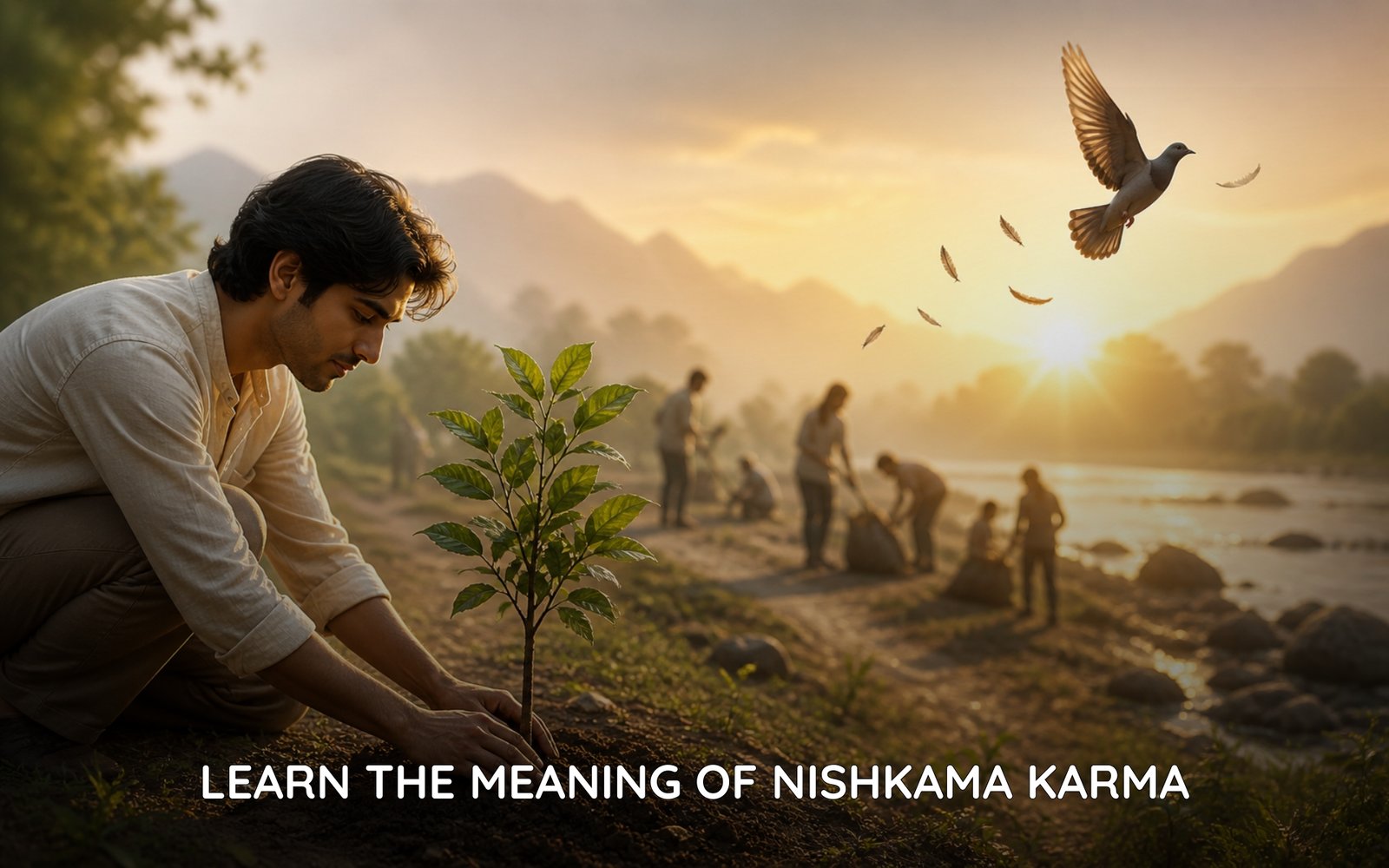
The main ethical and spiritual doctrine of the Bhagavad Gita is called Nishkama Karma (Sanskrit: Niṣkāmakarma), which can be translated as action without a desire or work without a motive. It is the habit of doing what should be done with a complete commitment and perfection, and being mindless of the fruits or results that come out of that work, be they failure or success, praise or reward. Nishkama Karma meaning is doing work without expecting any reward.
Realizing Nishkama Karma: The Heart of the Gita
Nishkama Karma is the most revolutionary of all the teachings in the Bhagavad Gita and the most misunderstood. It is found in the one most well-known verse of the whole book, BG 2.47, and it is the basis of Karma Yoga, the way of selfless action.
The Sanskrit word is decomposable as follows: nish (without) + kama (desire) + karma (action). It literally translates as desireless action. But this literal translation has led to centuries of confusion. Without any desire, how can you act? Why not do anything because you did not want something? The teaching of Krishna has a much deeper and more realistic meaning than the superficial interpretation. Nishkama Karma in Bhagavad Gita teaches selfless action as the path to peace.
Why Krishna Teaches Selfless Action – The Psychology of Attachment
The teaching of Nishkama Karma by Krishna is based on a thorough comprehension of human psychology. When we do things with attachment to outcomes, several destructive patterns come up:-
The Anxiety Cycle
Anxiety is always your companion when you are hooked to a certain outcome.
- Premeditative:- What will happen should I not? In the course of action: “Is it working?
- Post action:- Did I get what I wanted? This constant fear ruins your performance and your health as well. What is Nishkama Karma can be understood as action without desire for results.
The Ego Trap
When the results are received, the ego takes the credit: “I did this. When nothing happens, the ego takes the blame: “They did not allow me. Both responses are perversions. As a matter of fact, every result is the aggregate of a myriad of causes. What is Nishkama Karma can be understood as action without desire for results.
The Slavery of Reincarnation
Deeds done out of selfish desire lead to karmic ties that bind the soul in the circle of birth and death. The secret of doing without causing new bondage in the world is Nishkama Karma. Right action without attachment helps maintain inner balance and calmness.

Nishkama Karma Practice -Contemporary Applications
There are several factors in life where you can apply the Nishkama Karma.
In Your Career
The Nishkama Karma work attitude implies: do your job to an outstanding extent since it is your responsibility and not because of the promotion or a rise in salary. Ironically, such an attitude usually helps achieve greater success since it removes the fear and distraction caused by attachment. Karma yoga philosophy focuses on duty, discipline, and detachment.
Evaluate yourself through hard work and honesty, not just outcomes. Fear of failure should not make you avoid taking the required risks. Selfless action in yoga leads to spiritual growth and purity of mind.
In Relationships
Nishkama Karma, when applied to relationships, implies unconditional love. Get nothing back. Assist without receiving a reward. This is not tolerating abuse, but rather that your love is not a purchase and sale. Karma yoga explained, means performing duties without selfish motives.
In Creative Work
Nishkama Karma, practised by artists, writers and musicians, produces their best work. Write because you love to write, not because you want likes or followers or to sell books, and you will be authentic. According to BG 2.48, yoga is the ability of action. The greatest ability is produced when the ego is pushed aside. Detachment in action allows you to work without stress or fear of failure.
In Sports and Performance
The Gita teachings are reflected in modern sports psychology. This means that athletes are at their finest when they are in the zone, full engagement in what is happening, with no consideration of winning or losing. Nishkama Karma is the secular version of the process-over-outcome concept taught by elite coaches.
Nishkama Karma Classical Commentary
There are many significant personalities who have shared their thoughts on Nishkama Karma.
Adi Shankaracharya (Advaita Vedanta)
Shankaracharya sees Nishkama Karma as a preparatory exercise that cleanses the mind to make it ready to reach the ultimate goal of jnanam (knowledge). He claims that in the state of the mind being liberated from desire, it is in a state of calmness and is in a position to see the true nature of the self. To Shankara, Nishkama Karma is the transition between the action of the world and the knowledge of transcendence. Bhagavad Gita karma yoga teachings guide us to act without ego and attachment.
Ramanujacharya (Vishishtadvaita)
Nishkama Karma is viewed by Ramanuja as giving all actions to God (BG 3.30). The worshiper does not do it to benefit himself or herself, but it is a sacrifice to the Lord. This turns all actions, cooking, working, parenting, etc., into worship. The most important one is bhagavad-arpana buddhi: the disposition of giving all the actions to the Divine. How to practice Nishkama Karma includes doing your work sincerely without expecting rewards.
Madhvacharya (Dvaita)
Madhva stresses that Nishkama Karma can only be achieved by divine grace. Attachment cannot be overcome by the sheer power of the individual soul. It is through giving up to God and asking him grace that the devotee is given strength to do without any selfishness. This perspective emphasizes that bhakti (devotion) helps in the support of selfless action. The difference between karma and Nishkama Karma is that one seeks results while the other does not.
Mahatma Gandhi
Gandhi referred to the Gita as his eternal mother and based his whole philosophy of nonviolent resistance on Nishkama Karma. He explained the battlefield of Kurukshetra as the inner struggle between evil and good. To Gandhi, Nishkama Karma meant to struggle to achieve justice without hatred of the oppressor and without seeking power to be able to fight. The spiritual benefits of selfless action include peace, clarity, and freedom from ego.
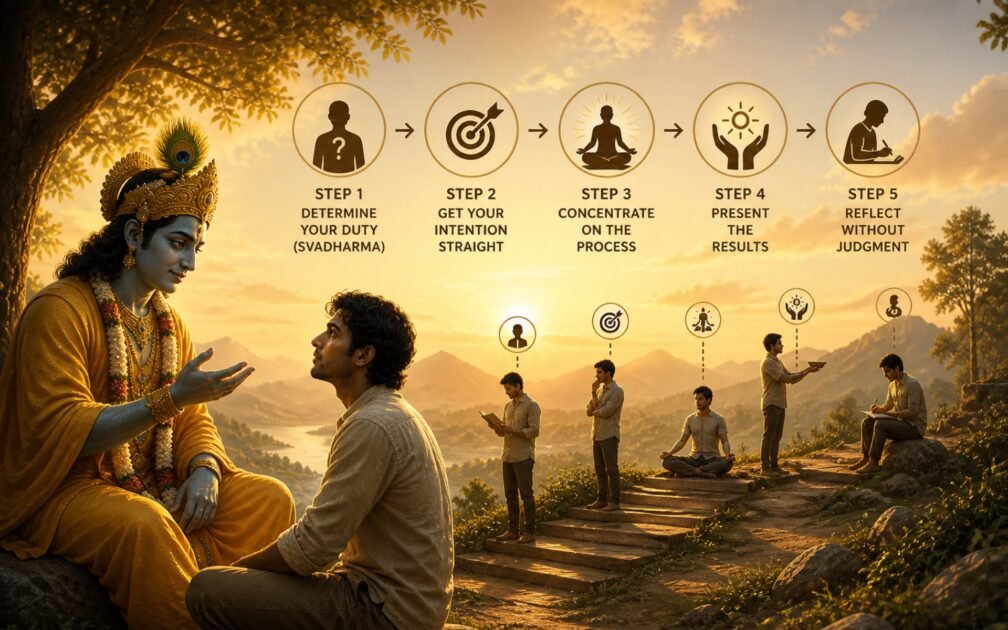
How to Start Practising Nishkama Karma Today?
- Step 1: Determine Your Duty (Svadharma)
What are your duties at this time? As a student, parent, employee, or citizen? Your dharma is not the same as that of everyone else, but rather that which suits your circumstances, abilities, and age.
- Step 2: Get Your Intention, Strauss
Always ask yourself the question before every important move: Do I do this because it is good, or because I want something out of it? Move gradually from outward motivators (reward, praise) to inward (duty, growth, service).
- Step 3: Concentrate on the Process
You must not think about the future, but focus on what you are doing now and how well you are doing it. This ability to remain present is reinforced by meditation.
- Step 4: Present the Findings
Once an action is done, devote the outcome of your action to something bigger than yourself, in your mind. BG 3.30 teaches: “Give all your works to Me, knowing Me, without profit motives.
- Step 5: Reflect Without Judgment
Analyze what you did to learn and better, but do not evaluate yourself using results only. Were you acting with integrity? Did you give your best effort? These are the real gauges of success within the framework of the Gita.
Nishkama Karma and Liberation of Karmic Bondage
The Gita explains that deeds done with the desire for self bring about karmic impressions (samskaras) which bind the soul in the repetitive birth cycle. The most important thing is that Nishkama Karma is the way to act without creating new karmic bondage.
The word yajna (sacrifice) is key. Action done as a sacrifice, to God, to duty, to the good of all, does not give rise to karmic bondage. The deed is burnt up in the flame of self-sacrifice, and there is nothing left. This is what can make one live a full life, being active and engaged and at the same time being spiritually free. Performing duty without expectations brings satisfaction and inner happiness.
A man who has given up all clinging to the outcome of his actions, being content and free in all things, does no fruitive action, though he may be involved in all manner of activities. Nishkama Karma examples in real life include helping others without expecting anything in return.
FAQs
What is Nishkama Karma in the Bhagavad Gita?
Nishkama Karma in the Bhagavad Gita refers to doing the duty without seeking the outcome. This is one of the most important lessons of Lord Krishna to Arjuna. It is action-oriented and dedicated to work, and the results are left to God, and it encourages selflessness, inner calm, and spiritual development.
What is the meaning of Nishkama Karma in simple words?
Nishkama Karma, in simple terms, means doing your job without any reward. You are not preoccupied with success or failure; you just do your best. It teaches us to be calm and positive, regardless of the outcome. This will ease the pressure and make us remain focused on our work with a calm and balanced attitude.
What is the difference between Nishkama Karma and karma?
Karma refers to any action and its consequence, where the actions are usually performed with anticipation. The difference between Nishkama Karma and doing actions without attachment to results is that Nishkama Karma is doing things without attachment to the results. Although karma could lead to stress because of expectations, Nishkama Karma brings peace as it only emphasises effort. It promotes unselfish service and minimizes emotional swings in life.
What do we do to practice Nishkama Karma in our daily lives?
We may perform Nishkama Karma by performing our duties in good faith without focusing on outcomes. Concentrate on diligence, integrity, and devotion in education, work, or love. Do not overthink results or incentives. Take success and failure equally. Another easy way to practice this principle every day is by helping people without any expectations of receiving anything in return.
What are the benefits of Nishkama Karma?
Nishkama Karma creates inner tranquillity, lessens stress and enhances concentration. It assists us to remain composed in success and failure. When we get rid of the attachment to results, we get more productive and positive. It also encourages selflessness and spiritual development. This attitude, over time, results in happiness, improved relations, and a meaningful and balanced life.
Yoga Teacher Training Courses in Rishikesh

100 Hour Yoga Teacher Training in Rishikesh

200 Hour Yoga Teacher Training in Rishikesh

300 Hour Yoga Teacher Training in Rishikesh






Leave a comment: