
- 293 Views
- 9 Min Read
- (0) Comment
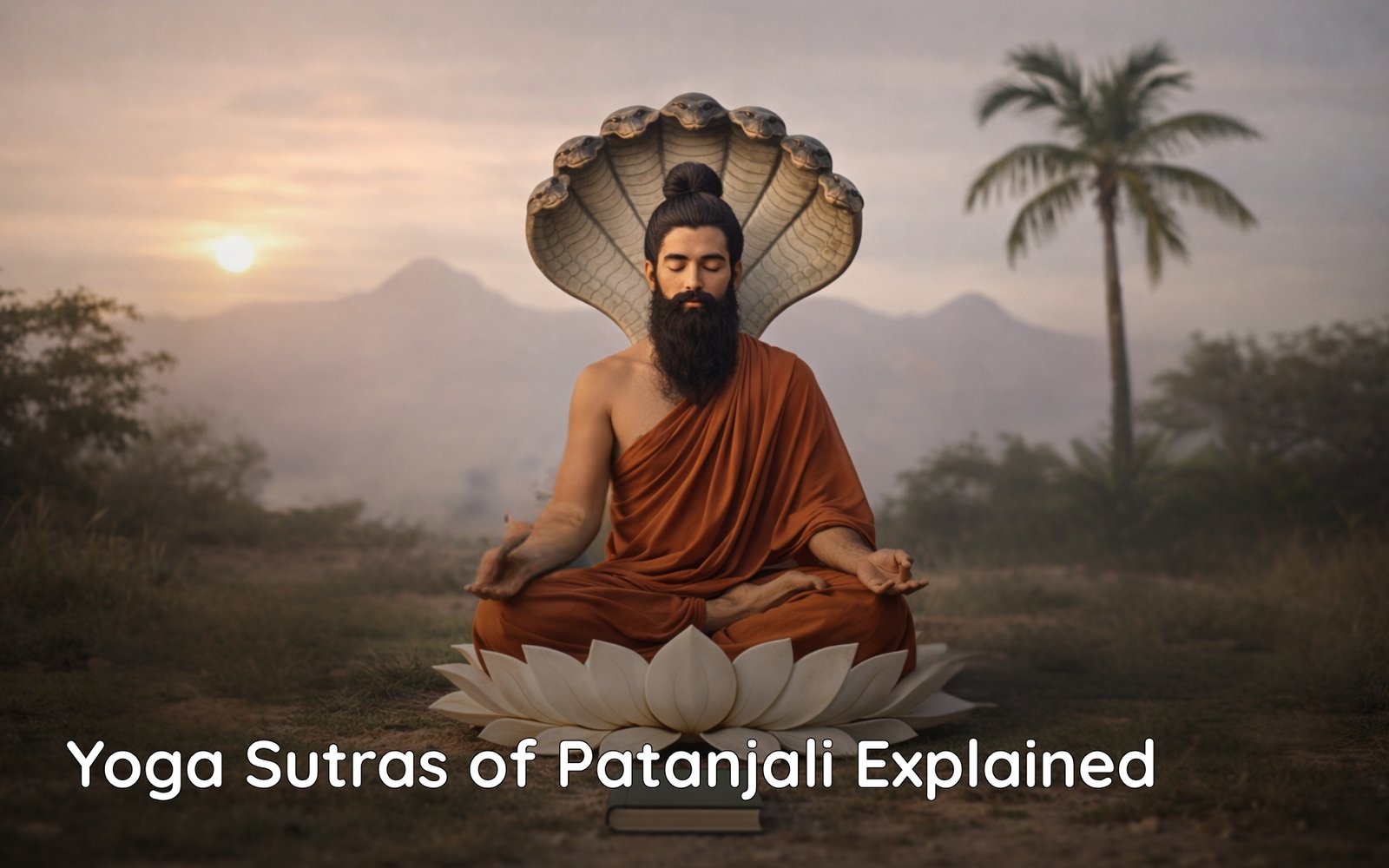
Yoga is usually associated with just physical postures, but the true essence of this practice lies in a text that was written over 1,7000 years ago: the Patanjali Yoga Sutras. For anyone who is starting their spiritual journey, you have to first understand Yoga Sutras of Patanjali explained simply, is the key to think yoga beyond mat.
To fully learn this philosophy, one person needs to see the yoga sutras explained simply to adapt how ancient wisdom applies to our daily stress.
In this guide, we will let you know the importance of Yoga Sutras in yoga, the four chapters of yoga sutras, and a proper detailed Patanjali Yoga Sutras Summary to help you understand your inner mind, soul.
What Exactly Are the Yoga Sutras of Patanjali?—
So did you ask yourself, “What are the Yoga Sutras of Patanjali?” Just imagine you saw a map that was written over 1,700 years ago, so that it is now considered as more precious and costly than gold, but it is not for materialistic things, it is for inner peace and an ultimate freedom within yourself. That is what these sutras are. These sutras are concise statements and short which is what we know as classical yoga sutras. The yoga sutra Patanjali meaning is timeless psychological and philosophical living life which has purpose, clarity and a pure peace. It is applicable for everyone, each and every person can experience this, if they practice it regularly and properly.
How Many Yoga Sutras Are There? And What Do the Chapters Hold?
A common question which comes in everyone’s mind is :How many yoga sutras are there? The simple answer will be 196 sutras, but there are some variations exist. What is very interesting to see is how accurately they are organized into four chapters of yoga sutras, each known as Pada. Here are those four chapters of Yoga Sutras:
- Samadhi Pada: This chapter makes us understand the main reason and goal of yoga, it explains that yoga itself is enlightenment, means Samadhi and how our mind works. In an easy way you can understand that this chapter gives answers for “what” and “why”of the yoga journey, consider it as the base of it.
- Sadhana Pada: Now this is the practical part starts from, sadhana means practice, and this chapter teaches you how to do it in practical steps. In this it has Kriya Yoga and the most popular Eight Limbs of Yoga, which you can explore in detail. This is considered as the “how to” guide for anyone who truly wants to understand this path.
- Vibhuti Pada: Now here is a path which you can get after doing regular meditation and for some years doing it, then you can get some sort of powers which can be called Vibhuti. This chapter describes such an experience but tells not to get distracted and leave doing yoga.
- Kaivalya Pada: The final chapter is known as Kaivalya, which means absolute freedom. It explains the detachment of the soul from material world and ego, leading a person to get proper freedom from the inner side.
Yoga Sutras for Beginners-
If you are thinking about what is the most practical and transformative path of the Patanjali Yoga Sutras, then it will be Eight Limbs of Yoga. In this you understand how to keep your mind still without any negative thoughts and actions. Let just see what are those:-
- Yamas: These are universal moral grounds, which everyone should follow. It is a behavior guide, which is very important to follow for a better social environment.
- Ahimsa: It means non violence which is not just physical but in thoughts and words also.
- Satya: This means speaking and living a truthful life, and being kind with others as well.
- Asteya: Here it means non stealing anything that is not yours and is given to you freely.
- Brahmacharya: It means enhancing your energy wisely and exercising self control.
- Aparigraha: Here being non – attachment means letting go of your greed and having only what is necessary.
- Niyamas: These are practices for your spiritual growth and your inner growth.
- Saucha: It doesn’t mean only taking a shower, it means purity of thoughts and words as well.
- Santosha: Here it means finding happiness in everything which you have right now, as it helps you be grounded.
- Tapas: Self discipline this is what it means, to clean your body and mind.
- Svadhyaya: In this it means self study which you can do from ancient text and books which have original and very powerful teachings in it.
- Ishvara Pranidhana: You have to surrender to the supreme power which has greater intelligence, but it means do your actions but the result leaves that for the supreme.
- Asana: This is where yoga journey of every person start, interestingly in the classical yoga sutras, Patanjali describes Asana as a very steady and comfortable seat for meditation.While modern yoga shows a lot of tough poses also, but the original purpose is to prepare body for better body posture.
- Pranayama: It itself means control over breath, people nowadays don’t even know that we are not breathing properly, when you do pranayama you then understand what breathing can do to your body and mind. It calms your nervous system and makes you focus more.
- Pratyahara: This teaches that turn your attention toward your soul and not into external distractions. It is not about blocking them, it is about controlling them.
- Dharana: This is the initial stage of focus, it means keeping focus on a single point without any interruption.
- Dhyana: When you have focus in your mind, then doing meditation is very easy, as you don’t need to gather the focus purposely.
- Samadhi: Now this stage is to just absorb all the power and energy of meditation.
The Psychology of Suffering: Understanding the 5 Kleshas
When we deeply understand Patanjali yoga philosophy, we came to know that Saga Patanjali did not just give us a map of philosophy but it actually showed human suffering also. These internal sufferings are called kleshas, if we want Yoga sutras of Patanjali explained simply, then we have to understand the sufferings also because this is what is blocking a person’s growth and mind.
- Avidya: This is the most common among all other kleshas, which is ignorance, which means to not see those things that truly matter but seeing ego as your true self.
- Asmita: This happens when we keep everything about ourselves only, then we start getting ego which is a sense of separation from the rest of existence.
- Raga: This is what we all dream of attachment to, it is somewhat good but if it is creating pressure then it is a suffering.
- Dvesha: This is the opposite of Raga, it means pushing away things which we don’t like, both attachment and hatred are powerful emotions which keeps the mind in a state of uneasy thoughts.
- Abhinivesha: The most powerful klesha is this one, it means intense fear of the unknown and it is powerful because you don’t know how to deal with such klesha.
At Atharv Yogshala, we believe that real yoga is not just about physical stretching; it is the process of the mind getting trained from these five kleshas to experience peace.
The Roadblocks to Peace: The 9 Antarayas
There are some times when a trained yoga seeker found obstacles which are known as Antaryas, they can delay your progress. These include physical illness (Vyadhi), mental tiredness (Styana) , doubt (Samsaya), and even frustration are also considered as obstacles.
Understanding these obstacles is an important part of yoga sutras for beginners because it teaches us that distractions are a natural part of human life. Instead of feeling guilty when you feel lazy or doubtful, the classical yoga sutras encourage us to see these obstacles and keep moving forward with proper focus.
The Abhyasa and Vairagya
To win against these obstacles, Patanjali gives us a simple yet powerful path: Abhyasa (Practice) and Vairagya (Detachment).
- Abhyasa means to remain consistently in a state of yoga. It is the discipline of showing up on your mat and practicing meditation every single day, no matter how you feel.
- Vairagya, on the other hand, is the art of letting go. It means doing the work but not being stressed with the results.
As we often discuss at Atharv Yogshala, the true benefits happen when you balance your effort with surrender. This approach gives you internal peace.
Why do we need Patanjali Yoga Sutras in modern life ?
In today’s stressed life, adding Patanjali Yoga sutras in our life has now become a need for our survival, because this philosophy works wonders for our mental well being. We live in an era where our mind doesn’t get time to relax and peace is also very far away. By doing concepts daily like Pratyahara or Santosha, we can protect our mind from getting negative and make us focus more on understanding our own self, which in this pace of life we don’t know.
Whether you are managing work stress or seeking emotional balance, these ancient sutras provide timeless ethical help for making us calm and centered.
The journey of finding yourself through Patanjali’s knowledge is endless. Finding
the yoga sutras explained simply can be the first step towards a more balanced life where a person has both physical and mental health at its best.
Conclusion
Understanding the Patanjali Yoga Sutras is a long run, not something which results came quickly. Whether you have started your journey with having knowledge of philosophy with Atharv Yogshala, these actually are the helpful element for your stress free life.
They transform your yoga from a simple physical workout into a powerful, energy focused way of living. By understanding the yoga sutra Patanjali meaning, you begin to see that yoga is a beautiful journey of knowing yourself, not a final destination. Start small, stay consistent with your Abhyasa, and watch how these ancient teachings bring clarity and peace to your modern world. These teachings not only help us in mentally relaxing but it helps us in transforming our inner self, because when we train our mind and emotions in a more positive and focused way it transforms our personality.
FAQ
1. How many yoga sutras are there in total?
There are precisely 196 sutras in the original text, but they have some minor variations in it across different translations.
2. What is the easiest way to explain the Yoga Sutras of Patanjali?
In a Patanjali yoga sutras summary, they can be explained as a science of mind. Where you get a step by step guide for how to control your mind, emotions and get peace.
3. How do the Yoga Sutras help with mental health?
Modern psychology often combines these ancient roots. For example, Aparigraha (non-attachment) helps reduce the anxiety caused by social media comparisons, while Saucha (purity) promotes a clean mental environment that reduces negative thought patterns.
Yoga Teacher Training Courses in Rishikesh
100 Hour Yoga Teacher Training in Rishikesh
200 Hour Yoga Teacher Training in Rishikesh
300 Hour Yoga Teacher Training in Rishikesh




Leave a comment: