
- 170 Views
- 5 Min Read
- (0) Comment
Bhakti Yoga is a very potent system of yoga. Its centerpiece is extraordinarily intense love that is directed towards God and is experienced by the practitioner. Bhakti is mainly created when the heart and the mind are purified through doing Karma yoga or giving service to other beings without any attachment. This purification results in meditation, and by meditating we become steady and focused in mind. Once the mind is pure, steady, and one-pointed, we can meditate on Iswara, the Lord.
Through this meditation we come to a point where we experience the Reality of Iswara. In experiencing Iswara, the feeling of Bhakti arises. The practice of Bhakti Yoga is where the aspirant is the lover, and Iswara is the beloved. By this process of love, the lover and the beloved become one. This is the process of union through love – Bhakti. Grace is one of the principal factors of the path of Bhakti Yoga, as everything that we get in this path is from Grace.
Association with the saints (satsanga) is one of the best means of achieving this Grace. Bhakti Yoga is a path of service – service of saints, service of the Guru and service of our fellow beings. This service is the source of blessings and Grace and the outcome is Divine Love. Bhakti Yoga is a very beautiful yoga which removes all the impurities of the mind and brings out another yoga, that is the yoga of knowledge or Jnana yoga, which removes ignorance and brings spiritual liberation or Moksha.
What is Bhakti?
Bhakti means divine love; Bhakti is the love that lies dormant in the heart of every living being; it is the pleasure that everyone wants, and it is the greatest potential in all beings. The true self, the atma, or soul, sees through the eyes and tastes through the tongue and so, things of this world can give some amount of satisfaction to the mind and senses, but not the atma; it is only love that gives fulfillment to the heart. Bhakti is the purest of that love, which is the connection of our true selves to its source—the ultimate connection man can have to anyone or anything alive is this connection.
The origin of Bhakti Yoga in India
Although Bhakti has been a part of India’s spiritual culture for thousands of years, over the course of time it became lost in rituals and prejudiced customs.
Around the sixth century C.E., a bhakti revivalist movement began to emerge around the writings of mystics who were gleaning the meaning from the ancient scriptures. These mystics were primarily from the South of India, and their close devotion and yearning for God was manifested in their philosophy, song, and poetry.
They made devotional revelations, and these revelations were slowly elaborated by their disciples and codified as devotional schools of yoga by scholars and saints such as Ramanuja (1017–1137), Madhva (1238–1317), Nimbarka (circa eleventh century), Vallabha (1479–1531), and Chaitanya (1486–1533). Focusing on sincerity of intent and development of character, these revered teachers ushered in a movement that is still growing.
Finally, in the 1960s, the bhakti movement came to the shores of other nations of the world in the hands of Radhanath Swami’s teacher, A. C. Bhaktivedanta Swami Prabhupada.
Nonetheless, although history offers a fascinating backdrop to the emergence of the bhakti movement, it is not bhakti itself that is contained in history. Bhakti—expressed as love for the Supreme—is the very nature of all souls and every religion or philosophy that tries to awaken its adherents to that love is practising bhakti.
The Four Pillars Of Bhakti
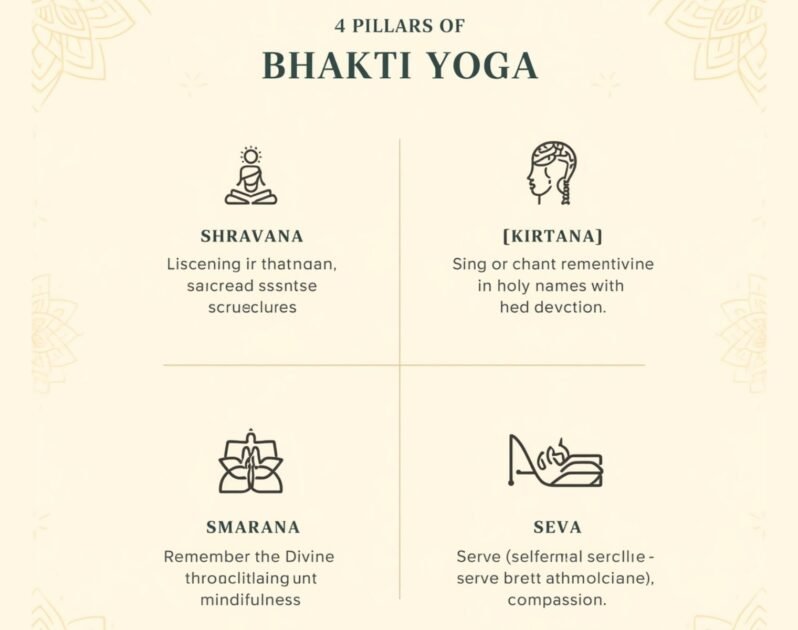
The following are the four main pillars of Bhakti yoga.
SADHANA
Our personal practice of connecting to our true selves and God through the power of prayer, meditation and acquiring knowledge. With these spiritual practices, we can attune ourselves to the frequency of grace of love and compassion that’s in us and when we carve out time every day to do this we create a very deep foundation and direction of life.
SATSANG
Being in the company of those people who uplift us as far as possible. When we come in contact with spiritual people, their experience and energy inspire us to carry on walking our spiritual path, help us to overcome hurdles and to avoid pitfalls.
SADACHAR
This is the attitude we have when we live our life and relate with people. The word ‘bhakti’ in essence, is to be in the mood of seva (selfless service).
SEVA
Seva is a selfless service and one of the important elements of Bhakti is to serve God with love, to serve His children and creation. With this principle of seva, we transcend differences based on culture, colour, religion, gender, age and even species, and live together in love and harmony.
Conclusion
Bhakti Yoga Sadhana is a path of devotion, love, surrender and connection to the Divine. The practitioners develop their inner peace, compassion and spiritual awareness through practices like chanting, prayer, meditation, selfless service and remembrance of God. Whereas the other paths are more about the mind and/or discipline, Bhakti Yoga is about the heart and the emotions. The Bhakti Yoga Sadhana can be a regular practice to alleviate stress, boost faith, balance emotions and bring a sense of purpose and unity to everyday life. When done with heart and integrity, this practice can be a transformative experience with a path to spiritual satisfaction and inner harmony.
FAQs
Bhakti Yoga Sadhana is what?
Bhakti Yoga Sadhana is a devotional spiritual practice which involves the development of love, faith, and surrender to the divine through prayer, chanting, meditation, and selfless service.
What are the main practices in Bhakti Yoga?
The mantra chanting (japa), kirtan, recitation of prayers, devotional singing, reading of sacred texts, meditation and seva (selfless service) are common practices.
Who is eligible to do Bhakti Yoga?
Bhakti Yoga is available to all regardless of age, background, religion or spiritual experience.
What are the advantages of Bhakti Yoga Sadhana?
Some benefits include emotional healing, stress reduction, inner peace, concentration, compassion, the development of spiritual abilities and deepening of the connection with the Divine.
Is there any specific religion to practise Bhakti Yoga?
No. Bhakti Yoga has nothing to do with religion or belief system; anybody can practice it in their own way.
What is the difference between Bhakti Yoga and other Yogas?
Other types of yoga may emphasize on physical postures, meditation, knowledge or disciplined action; however, Bhakti Yoga emphasizes the devotion to and love for the divine.
Yoga Teacher Training Courses in Rishikesh
100 Hour Yoga Teacher Training in Rishikesh
200 Hour Yoga Teacher Training in Rishikesh

300 Hour Yoga Teacher Training in Rishikesh




Leave a comment: